Wet Carpet Drying in Brisbane: What You Need to Know
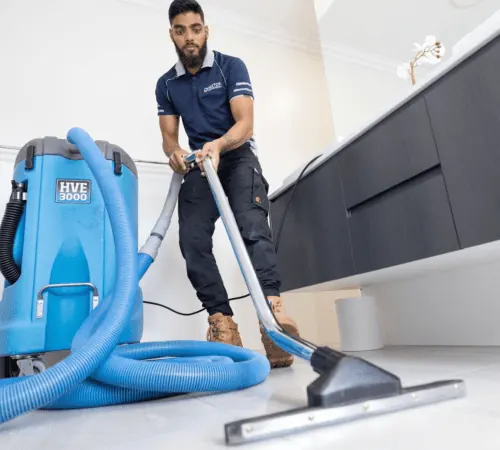
Water still in the house? Turn off the water if it is safe, keep clear of power points and call 1800 739 867. Standing water comes out first with water extraction, then the carpet, underlay and subfloor are dried and checked with moisture meters. Reztor provides restoration documentation to support insurance claims. Your insurer determines policy coverage and claim outcomes. Every job starts with a $198 initial assessment.
How long does wet carpet take to dry?
For a clean-water leak in one or two rooms, extraction plus air movers and dehumidifiers commonly dries carpet and underlay in about two to five days. Soaked underlay, concrete slabs, timber subfloors, closed-up rooms and Brisbane’s humidity can all make it take longer. Left to dry on its own, carpet can feel dry on top while the underlay and slab stay wet for a week or more. That is why we take moisture readings before we finish drying and talk you through the results, rather than going by how the carpet feels.
Clean, grey or black water: why the source matters
- Clean water (Category 1): a burst supply pipe, leaking flexi hose, hot water system or overflowing basin with clean water. Carpet and underlay can often be dried in place if extraction starts early.
- Grey water (Category 2): a washing machine, dishwasher or shower leak. The carpet usually needs cleaning and an antimicrobial treatment, and the underlay is often replaced.
- Black water (Category 3): sewage, a toilet overflow with waste, or storm and floodwater from outside. Affected carpet and underlay are usually removed and disposed of safely. Don’t run fans over it. See sewage clean-up and our flooded carpets Brisbane guide.
Clean water doesn’t stay clean for long. After a day or two in a warm house it can carry bacteria, which changes what can safely be kept.
Can the carpet be saved, or does it need replacing?
Carpet is often worth drying when the water was clean, the leak was found early and the backing is still bonded. Underlay soaks up water like a sponge and costs far less than carpet, so it is commonly replaced while the carpet itself is dried and re-stretched. Replacement is more likely when:
- the water was sewage or outside floodwater
- the backing has separated from the fibres (delamination)
- the carpet has shrunk, wrinkled or pulled away from the edges and won’t re-stretch
- a musty smell or mould remains after drying
- the carpet stayed wet for several days before anyone found it
More detail: can the carpet be saved after water damage?
Carpet, underlay and subfloor: a decision for each layer
The carpet is only the top layer. A surface that feels dry can still leave moisture below, so the assessment looks at the whole floor, and each layer gets its own decision:
- Carpet and backing: the pile can lose visible moisture before its backing does. Whether the carpet is kept depends on whether it can be properly cleaned and dried, and on any damage to the backing or fibres.
- Underlay: saving the carpet doesn’t always mean saving the underlay. Its material and condition decide whether it stays or is removed, sometimes to reach the floor beneath.
- Timber or concrete subfloor: this needs checking before the carpet goes back down. Moisture readings and material damage decide the drying, access or repair work needed.
- Room edges and nearby flooring: water can spread past the carpet into skirting boards, timber, laminate or vinyl, which may need their own assessment.
These are the things we assess, not a promise that every material can be saved. Photos can’t confirm the condition of hidden layers.
Wet carpet smell and mould risk
A damp, musty smell usually means moisture is still sitting in the underlay, the carpet backing or the floor underneath. In warm, humid Brisbane conditions, mould can start growing on wet materials within a day or two. Drying the hidden layers, not just the surface, is what stops the smell coming back. If mould has already started, see mould remediation.
DIY mistakes that make wet carpet worse
- Using a household vacuum on wet carpet. It isn’t built for water and can be an electrical hazard.
- Heaters or hair dryers. Heat can shrink carpet and dries unevenly, while the underlay stays wet.
- Steam cleaning before the carpet is dry, which pushes more moisture into the underlay.
- Running fans over grey water, sewage or floodwater, which can spread contaminants through the house.
- Putting furniture back on damp carpet. Timber and metal legs can stain the carpet, and moisture stays trapped underneath.
For a small clean spill, our guide on how to dry wet carpet covers the safe steps you can take yourself.
Wet carpet drying near you
Our own team covers Brisbane CBD and Brisbane suburbs, plus nearby areas, with help available 24/7: wet carpet drying Logan, Redlands, Moreton Bay, Ipswich and the Gold Coast. If water has spread beyond the carpet into walls, cabinetry or the subfloor, see structural drying and water extraction in Brisbane.
Wet carpet right now? Call 1800 739 867, 24/7.